
Nobody announced it. Nobody signed off on it. But right now, inside your firm, AI is working.
It's summarising deal memos. It's drafting investor communications. It's sitting inside your document management platform, your inbox, your scheduling tools — quietly shaping outputs that carry your firm's name. Your analysts are using it. Your operations team is using it. Possibly your CFO's executive assistant is using it.
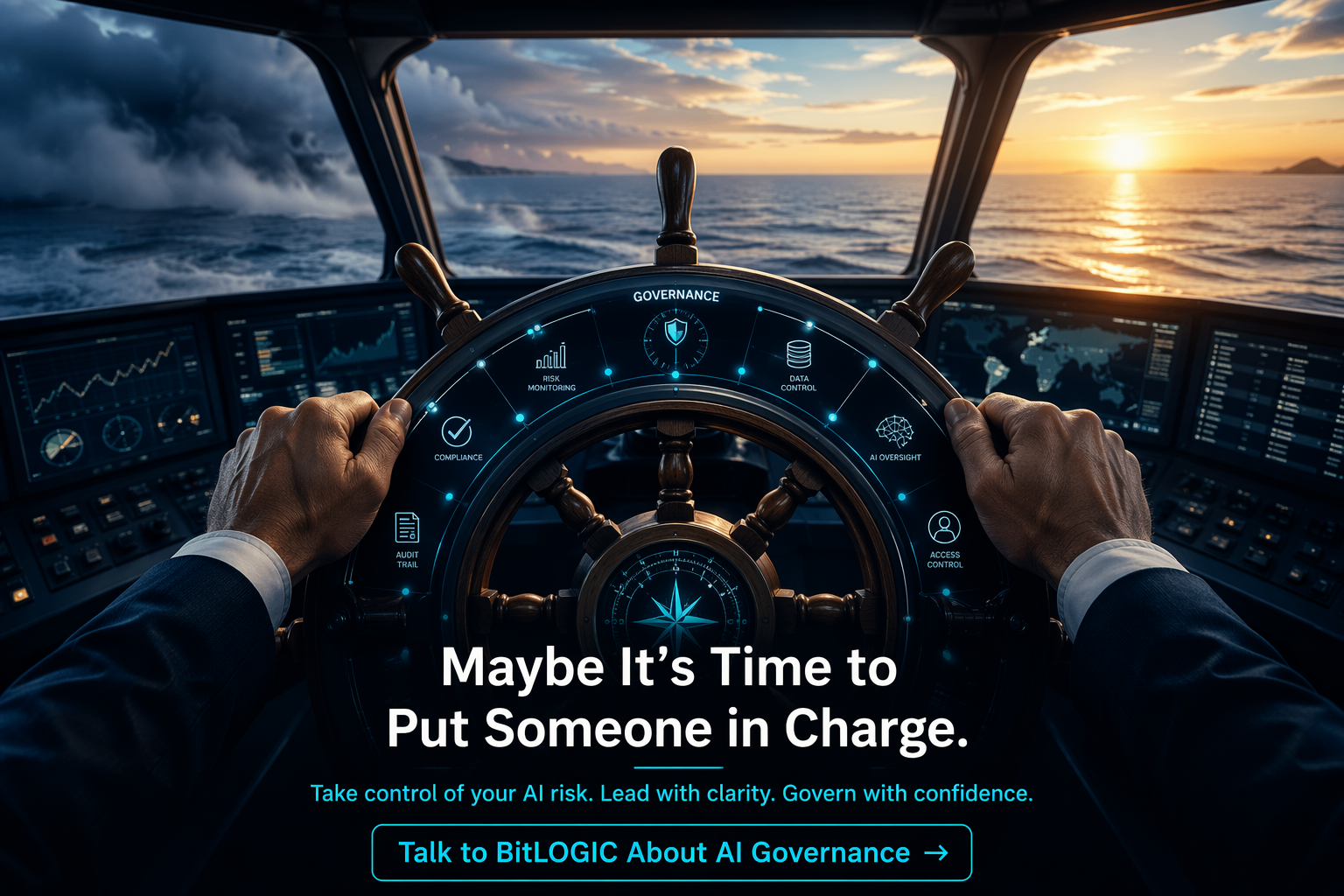
The question is not whether AI is in your business. That question was settled a while ago. The question — the one that should be on every principal's radar right now — is whether anyone is governing it.
The Tools Are Ahead of the Policy
Here is what ungoverned AI looks like inside a finance or private equity firm on a normal Tuesday.
A team member pastes a confidential information memorandum into a generative AI tool to produce a first-cut summary. The data leaves your environment. Where it goes, how long it is retained, and what the provider does with it are governed by terms and conditions that nobody in your firm has read, let alone approved. The output comes back looking clean. The risk — legal, reputational, regulatory — is invisible.
Elsewhere, an AI writing assistant is being used to draft LP update communications. The tool is trained on previous inputs. Some of those inputs included commercially sensitive language. The model has stored context. Nobody mapped that as a risk, because nobody mapped it at all.
This is not an edge case — it is a pattern that is increasingly common across mid-market finance and investment firms. Across Australian businesses broadly, only 34% are actively using AI tools, and the majority remain limited to off-the-shelf generative AI. Only 5% have deployed AI automation beyond a pilot stage. The tools are fast, easy, and genuinely useful — which is exactly why people adopt them without waiting for a policy that never arrived.

Why Finance and PE Firms Carry Heightened Exposure
Every Australian business carries some level of AI-related risk. But for firms operating in finance and investment management, the exposure is amplified.
You hold sensitive financial data, personal information, and commercially privileged materials as a matter of course. Your obligations under the Privacy Act 1988 are not abstract — the maximum penalties for serious or repeated privacy breaches now reach $50 million or 30% of annual turnover, whichever is greater. The accountability sits at board and principal level. It does not diffuse across the organisation.
The ACCC is also paying increasing attention to how AI systems interact with consumer outcomes and market conduct — a signal that AI governance is not a back-office concern. It is moving into the regulatory foreground, and finance is a sector under scrutiny.
Beyond legal exposure, there is the commercial and reputational dimension. Your investors and counterparties expect that the data and communications they share with you are handled with appropriate controls. An AI governance failure — a data leak, a compliance breach, an undisclosed AI-generated document — is not just an operational problem. It is a trust problem, and in this industry, trust is the asset.
What AI Governance Actually Involves
"AI governance" can sound like a compliance project. In practice, it is a set of straightforward management disciplines applied to a new category of tool.
It starts with visibility. You cannot govern what you cannot see. That means understanding which AI tools are in use across your firm — not just the ones IT provisioned, but the ones individuals have adopted through browser extensions, free-tier subscriptions, and embedded product features. Shadow AI is real, and it is almost certainly operating in your environment.
From there, governance involves classification — understanding what data those tools are accessing, processing, or storing, and whether that aligns with your data handling obligations. Not every tool is a risk. But the risk profile is not the same across all of them, and without a framework, the assumption tends to be that everything is fine.
Then there is policy and accountability — clear rules about which AI tools are approved, what they can be used for, and who carries responsibility when something goes wrong. Global frameworks like ISO/IEC 42001 (the international standard for AI management systems), ISO/IEC 27001 (information security management), and the Australian Signals Directorate's Essential Eight (a prioritised cybersecurity mitigation framework) provide structured reference points. They are not bureaucratic exercises — they are the scaffolding that makes AI adoption defensible.
Finally, governance involves ongoing oversight. AI tools change. Providers update their terms. New capabilities are introduced. A governance posture that is set once and never revisited is not a governance posture — it is a snapshot.
The Gap Many Firms Are Operating In
The honest reality is that many mid-market finance and investment firms in Australia are currently operating in the space between early AI adoption and structured governance. The tools have outrun the frameworks. That is not a criticism — it reflects the pace at which these tools have become embedded in everyday workflows.
What it does mean is that the window for establishing clean, defensible AI governance is now. The organisations that move deliberately — who map what they have, set appropriate controls, and build a clear accountability structure — will be in a materially better position as regulatory attention increases and as the expectations of institutional counterparties and investors continue to rise.
Waiting for a regulatory event to force the conversation is a legitimate strategy. It is also the most expensive one.
A Partner Who Understands the Environment
BitLOGIC works with Australian finance and investment businesses that take their operational and security obligations seriously. We are not here to sell AI tools — we are here to help you understand what AI is already doing inside your business, assess the risk it carries, and build a governance structure that is proportionate, practical, and defensible.
That means an audit of what is actually running in your environment. It means a clear-eyed conversation about data handling, tool classification, and accountability. It means a framework that your team can actually operate — not a document that lives in a folder.
For CFOs and commercial decision-makers: the cost of an AI governance failure — regulatory penalty, client notification, reputational damage, operational disruption — is materially higher than the cost of establishing clear controls now. Governance is not a sunk cost. It is a risk management investment with a measurable return.
We do not overclaim what AI governance delivers. It will not eliminate risk. What it will do is give you visibility, control, and the ability to demonstrate that you are managing this deliberately — which is increasingly what regulators, investors, and counterparties will ask for.
The Situation Is Manageable — If You Start Now
AI governance does not require a transformation programme. It requires a clear starting point: knowing what you have, understanding the risk it carries, and making a deliberate decision about how you manage it going forward.